
Writing Better Music: Core Songwriting and Composition Skills for Modern Creators

How a Song Comes Together
Have you ever wondered how a song comes together? Maybe you have some ideas of your own and you want to see them through. Maybe you are inspired by other music creators, and you want to make something of the same caliber.
Writing music is an equal blend of intuition and structure. You don’t need a degree in theory to write something beautiful - but you do need a few core principles that help your ideas feel intentional, expressive, and emotionally compelling.
Most modern creators work in DAWs, not on staff paper writing out notes by hand. But the fundamentals of melody, harmony, and musical storytelling still matter. They’re the difference between a song that wanders and a song that connects.
This guide gives you Embervane's foundation for writing better music. You’ll learn how chord progressions work, how melodies take shape, how to add interest when your ideas feel flat, how modes can expand your palette, what makes melodies catchy, and how to develop ideas into full songs.
Let's dive in!
Chord Progressions: How Harmony Shapes Emotions
Harmony is the emotional backbone of your music. And chords make up the harmony. Think of harmony like a backdrop to a play - they set the mood of the scene for the main characters.
As the scenes change, the backgrounds change - and that changes the mode. Those 'scene changes' in music are changes in the chords. String several changes in a row and you have a chord progression.
A chord progression sets the mood long before the melody arrives. The good news is that you don’t need to know complex music theory to write progressions that sound good.
You just need to grasp how chords relate to one other and how they create movement and emotion.
Why Chord Progressions Matter
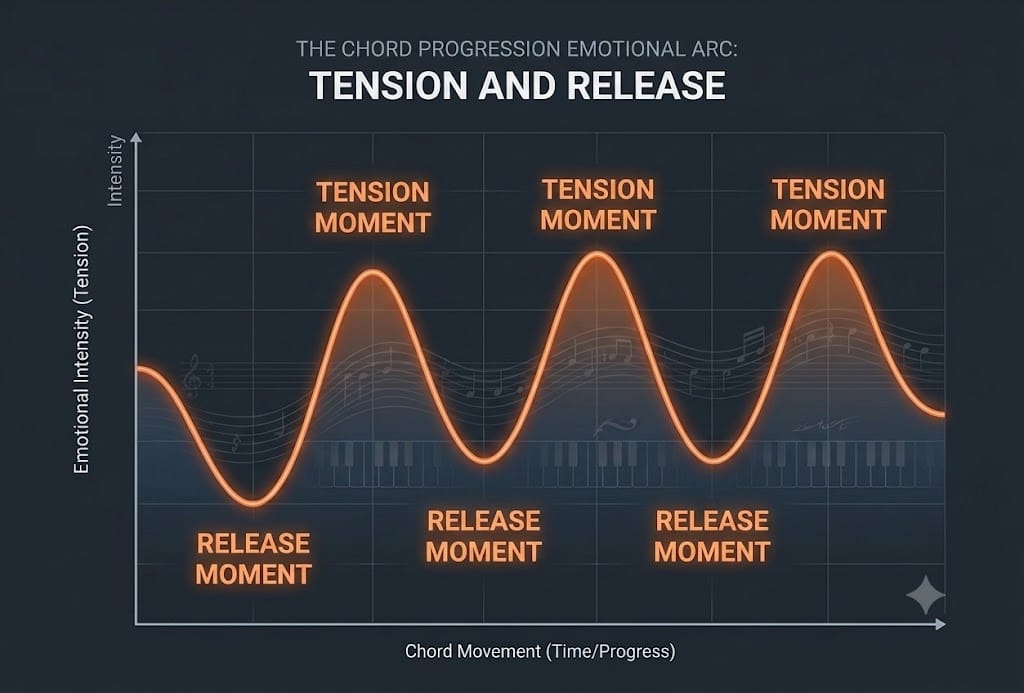
A good progression gives your song direction. It creates tension, release, expectation, and resolution.
Even simple progressions like I–V–vi–IV or ii–V–I can carry enormous emotional weight because they follow patterns listeners intuitively understand.
If this string of Roman numerals is confusing, just know that is part of the chord labeling system inside of a musical key (an agreed upon set of notes, especially the first). Don't sweat it for now, unless you want to dive deeper into the basics of music theory without getting bored.
Let's listen to that I–V–vi–IV chord progression and hear how it makes you feel.
And here is what that ii-V-I chord progression sounds like - how do you feel with this one?
Did you notice that the first chord progression has a kind of hopeful feeling throughout. This progression is called the "Hero's Journey.". You might find this kind of progression in pop songs and is arguably the most successful progression in commercial music history.
But the second progression starts with that ii chord that is less settling, and yet settles very cleanly into the home base of the key at the end. The chords feels satisfying and resolved. This progression is more of a jazz, R&B, and classic musical theater kind of chord progression, although you will also find it in pop songs as well.
The Role of Key
The key is the home of the song. It sets the main scale of notes that are going to be played and which one is the 'main' note of your song. (A scale is just a set of notes - don't worry about that right now).
A musical key is one of the twelve notes in the Western system that serves as the home base for a song. Musical notes stretch from the letter A through G. Throw some sharp or flat 'half-notes' in there, and you end up with twelve notes in the Western system. One of those twelve notes will be your key.
If we wanted to stick with the all-white keys of the piano starting with the C-note, you would have a key of C. The notes of that scale would be C-D-E-F-G-A-B.
If we take this a step further, we get to seven core chords in every key. These chords tell you where you are in the scale, from chords that feel stable (I, vi) and chords that feel tense (ii, IV, V), you can shape emotional arcs without guessing.
Movement and Storytelling
When you are changing chords, you are creating a small mood shift. When you purposefully match those mood shifts to the storytelling of the song, you can create beautiful movement in the harmony.
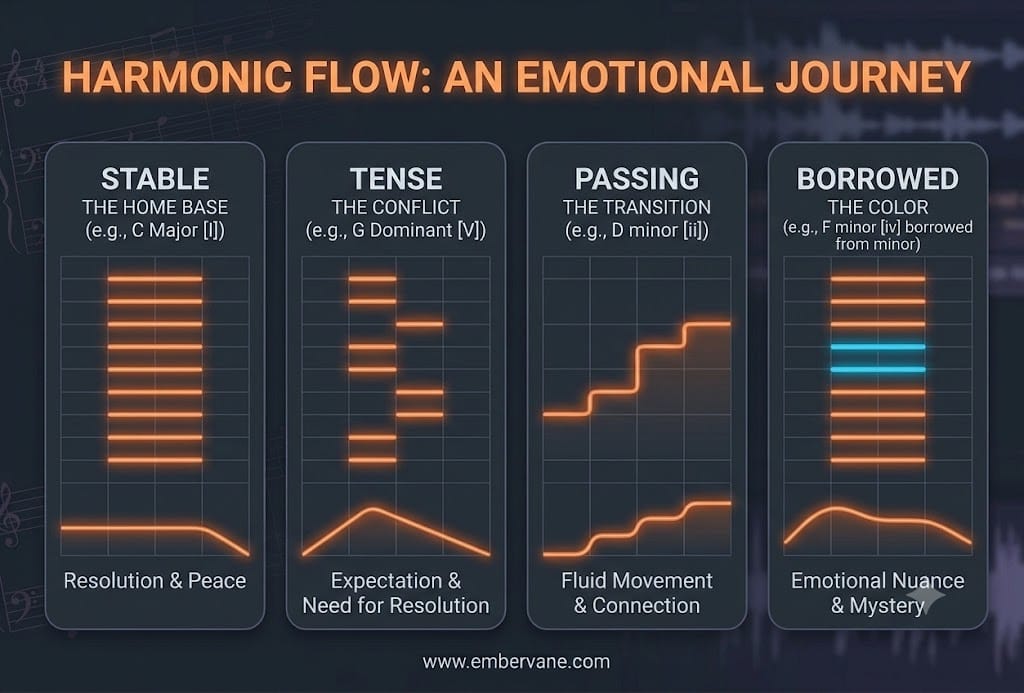
But not all chords in your toolbox feel the same. Here are some examples:
Stable chords feel calm (like the I chord)
Tense chords feel unresolved (like the vii chord)
Passing chords create motion (a transition chord)
Borrowed chords add color (taking some notes from outside the scale)
Now, you might be looking at these words thinking, "What the fritz is this guy talking about?" Well, don't worry.
You don’t need to memorize these names or the theory to start - you just need to listen for how each chord feels and start simply. Just like building any other skills, start with the fundamentals and then work to expand your toolkit.
Modern Progression Techniques
Today, modern producers often use:
Loop‑based progressions for pop and EDM
Borrowed chords for color
Pedal tones for tension (this is a repeating bottom note)
Sparse progressions for emotional minimalism
These are just a couple of ideas, but the palette is expansive with chords. And you get to choose the colors.
When you are starting out, keep it very simple. It is much easier to add color to an undeniable structure than it is to try and simplify something that is a mess.
Melody Writing: How to Create Lines That Stick
While I personally feel that you should write the melody first, I put it after chord progressions in this guide because chords are easier to mess with at first. Writing melodies can feel really daunting.
But the melody is the part of your song people remember. It’s the hook, the emotional center, the thing listeners hum long after the track ends. (We don't normally hum the harmony, right?)
It is also the notes and rhythms that would carry the lyrics, if words will be added to the song. Amazingly, writing melodies isn’t about talent - it’s about understanding shape, rhythm, and repetition.
Melodic Shape
Great melodies move with intention. They rise, fall, and rest in ways that feel natural. There is a shape to them.
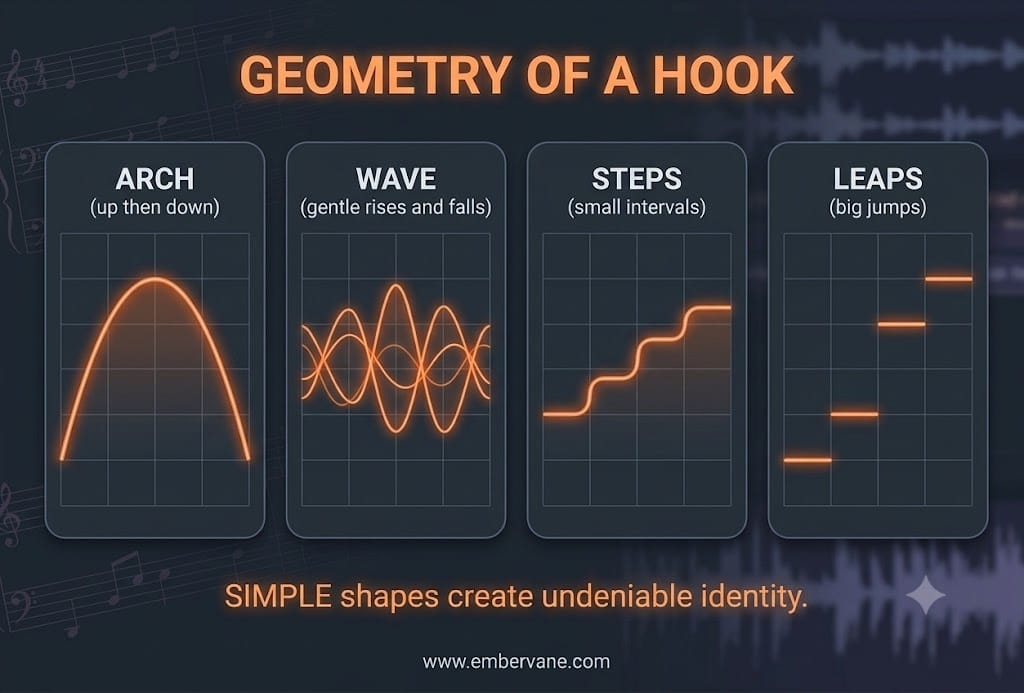
Most memorable melodies follow simple shapes:
Arch (up then down)
Wave (gentle rises and falls)
Steps (small intervals)
Leaps (one or two big jumps for drama)
The melodic shapes creates identity - kind of like a musical fingerprint.
Listen to the melodies in these movie themes and try and figure out where these melodic shapes are being used:
"The Raiders March" from Raiders of the Lost Ark -
Composed by John Williams
"My Heart Will Go On" from Titanic -
Composed by James Horner, vocals by Celine Dion
"Gonna Fly Now" from Rocky -
Composed by Bill Conti
"The Raiders March" from Raiders of the Lost Ark -
Composed by John Williams
"My Heart Will Go On" from Titanic -
Composed by James Horner, vocals by Celine Dion
"Gonna Fly Now" from Rocky -
Composed by Bill Conti
And just like orchestral scores use shapes to tell a story without words (most of the time), classic pop and rock songs use these same geometric lines to stick in your brain for decades.
Take these songs as an example:
"Hey Jude" -
The Beatles (1968)
"Don't Go Breaking My Heart" -
Elton John & Kiki Dee (1976)
"Sweet Child O' Mine" -
Guns N' Roses (1987)
"Hey Jude" -
The Beatles (1968)
"Don't Go Breaking My Heart" -
Elton John & Kiki Dee (1976)
"Sweet Child O' Mine" -
Guns N' Roses (1987)
Rhythm Matters More than Notes
Many beginners focus on pitch, but rhythm is what makes a melody feel alive.
That's right - rhythm.
Think about the theme from the movie Jaws - two notes, man... that's it for a long while. And the very first two notes are burned into the minds of anyone that has watched the movie. That long-short combo is almost all rhythm.
Long notes create space - short notes create urgency. Repetition builds familiarity - syncopation adds interest. (Syncopation is basically getting funky with the rhythms by making the strong beats weak and the weak beats strong.)
Reptition and Variation
Face it - humans love patterns. A strong melody repeats ideas, then changes slightly and then goes back to the its original state.
If we assign the original melody the letter A and the variation melody the letter B, we end up with something like this: A–A–B–A
This balance keeps the melody recognizable without becoming boring. Because if you went A-A-A-A, our minds will crave some kind of change happening there.
We are natural predators with stereo eyes and ears. That kind of setup naturally keys in on differences. Give your melody enough repetition that the variation feels bigger than it really is.
Melody and Harmony Working Together
A chord progression alone lacks the 'lead voice' of the melody. A lonely melody lacks the emotional backdrop of the harmony.
If you are starting with the melody, then your harmony will sound best when the chosen chords outline the melody. The chords play background support to the melody, but color it along the way.
If you happened to start with the chord progression first, then you need to make sure your melody falls within the bounds of the chosen chords. If you don't, then things are going to sound off.
Now, you don’t need to hit chord tones constantly. I am talking about landing on them at key moments to create stability and not to stray too far out of bounds that things feel disconnected.
Modern Melody Technique
There are several techniques that you can employ to give your melodies some life:
Call and response (using two different instruments to share parts of a melody - bouncing back and forth between one another)
Motif development (building a melody from smaller bits)
Pentatonic scales for simplicity (this means using less notes in a scale)
Melodic hooks built from rhythm first (focus on the rhythm and the notes will come to you later - if the rhythm is locked, you are golden)
Vocal‑like phrasing even for synth leads (boy, that might be easier to put lyrics over, right?)
Remember that writing a melody is like writing a story. And understanding good storytelling techniques will help you to become a better songwriter.
To start, focus on simple melodies and lock them in. Nothing is more undeniable than a rock-solid melody earworm.
Adding Interest: Why Music Sounds Boring (and How to Fix It)
So, you have a melody and you have some chords. But do you have a song? Not quite yet.
Every creator hits a point where their music feels flat. The chords are fine, the melody is fine, but the song doesn’t move.
This usually isn’t a talent problem - it’s an interest problem. And to understand how we can make our songs come alive, we need to take a look at why songs might feel boring.
Why Songs Feel Boring
Nothing is worse than getting bored when listening to music. I mean, we listen to music specifically not to be bored, right?
Here are some of the reasons that music can feel boring:
everything stays the same
there’s no contrast
the rhythm is too predictable
the melody lacks shape
the harmony doesn’t change
the arrangement is static
Remember that predator brain? Well it craves change. Even small shifts can transform a simple idea into something compelling.
Remember - it doesn't want to complete chaos. The idea is to stand firmly on two feet scanning an environment while noticing the little changes that are happening as everything shifts.
Do that in your music and you are going to keep people's attention.
Contrast is Everything
Contrast in your song creates emotional impact. And that impact can be dialed up or down depending on how hard you want it to hit.
Humans are funny beings - we like things to be the same and to have variation at the same time. Imagine watching the same television episode over and over again. You would get bored pretty quickly... but move on to the next episode in the same setting with the same characters but different dialogue or situations and things stay exciting.
Here are some ways you can add contrast to make your songs feel more alive:
Dynamics (quiet vs loud)
Texture (thin vs full)
Harmony (stable vs tense)
Melody (steps vs leaps)
Rhythm (straight vs syncopated)
Arrangement (minimal vs layered)
Micro-Variations
Remember when I said that we can dial the impact of contrast up or down? Well micro-variations are one way to control how the song changes without having a direct impact. This is like standing outside and the trees are lightly moving with the wind - a subtle variation that keeps the scene feeling alive
Here are some ways to use micro-variations to keep listeners engaged:
change one note in a repeated melody
add a passing chord
shift the rhythm slightly
introduce a new instrument
remove something instead of adding
Holding listener interest doesn't require complexity or a bunch of stuff going nuts - it just requires some movement, and subtle movement can be very effective here.
Modern Interest Techniques
Let's look at some practical methods of adding interest into your song that you will hear used in modern songs:
ear candy (small details that appear once)
automation (filters, volume, reverb)
layering (multiple sounds playing the same part)
call‑and‑response between instruments
section‑based contrast (chorus bigger than verse)
When working to keep the interest of a listener, use these tools to let your song live and breathe like it was a living scene. The better you do that, the more you will find people captivated by your music.
Modes: Expanding Your Musical Palette Without Confusion
I need to bring up a music theory element here, but don't worry - it is fundamentally simple.
Remember that C-major scale we talked about before: C-D-E-F-G-A-B
Well, what if you kept all of those notes together, but you decided to start on a different note - like F. Now, the scale would go: F-G-A-B-C-D-E
Same note order, but a different starting point. Well, that is called a mode of a scale.
Modes are one of the most misunderstood concepts in music theory, although you saw how fundamentally simple they are. Why use one? Because each mode has a distinct emotional character.
Why Modes Matter
Stuck with a song that is feeling a little flat? Maybe using a mode would help?
Modes help you write music that feels fresh and different. They give you new colors, new moods, and new melodic possibilities without requiring complex theory.
The Seven Modes (Greek Language Alert!)
Okay, I am going to list out the technical names of the different modes. But, man - these may not stick right away. Don't worry about that!
Just remember, all these names are just codewords for how many notes you shifted over from the original. When we moved over from C to F in our mode example above, we moved to the fourth mode: C to D to E to F.
So, look at the descriptive words and don't focus on the names if they freak you out. I will put a comment if this was the C major scale, but you can apply it every scale.
Ionian: major, bright (i.e., start on C)
Dorian: cool, soulful (i.e., start on D)
Phrygian: dark, tense (i.e., start on E)
Lydian: dreamy, floating (i.e., start on F)
Mixolydian: bluesy, open (i.e., start on G)
Aeolian: minor, emotional (i.e., start on A)
Locrian: unstable, rarely used (i.e., start on B)
How to Use Modes Without Getting Lost
The key is to focus on character, not theory.
Ask: What mood do I want?
Then choose the mode that matches it.
Yeah, you got that right... you chose the mode by picking the mood you are going for. Play with it and have some fun.
Modes in Modern Music
In modern songs, producers will use modes to do the following:
write unique chord progressions
create fresh melodic ideas
break out of the major/minor rut
add emotional nuance
shape genre‑specific sounds
Remember that modes are tools, not rules. Play with them see what kind of music you can make.
Catchiness: The Science of What Listeners Respond To
Catchiness isn’t luck - it’s psychology. And psychology is all about understanding how our brains work.
Certain melodic patterns, rhythms, and intervals resonate with listeners because they’re easy to remember and emotionally satisfying.
Have you ever had a commercial jingle get stuck in your head after only hearing it once? That's catchiness in action.
Repetition is the Foundation
Catchy melodies repeat ideas. Repetition builds familiarity, which makes the melody easier to remember.
When you are looking for something catchy, you can play with only one note and focus on the rhythm. When you find something that excites you, you're on the right track.
Predictability vs Surprise
Listeners enjoy melodies that feel predictable enough but still include small surprises. This goes back to the idea of standing by the trees that are lightly moving. The whole scene is stable, but there is subtle movement that catches our attention - the sway of the trees, a squirrel jumping between branches, a bird flying, etc.
To keep the song balanced and engaging, think of things like this:
predictable rhythm
surprising interval
predictable shape
surprising ending
Contour and Movement
The best melodies tend to be catchy. And catchy melodies often have simple melodic shapes. That melodic shape is more important than complexity.
Simplicity is effectiveness, so look for your melody to use:
small steps
one or two leaps
clear direction
strong rhythmic identity
The Role of Rhythm
Many hooks are rhythmic first, melodic second. Short, punchy rhythms stick in the mind.
Notice how many times rhythm has come up in this guide? It really is that important. If you are stuck, go back to the rhythm and figure it out, because everything else will follow that.
Cognitive Anchors
A cognitive anchor is a term from psychology. It describes how our brains like to latch onto some things and use them like a benchmark. From that benchmark, our brain then compares other similar things it experiences.
It is one of the ways your brain saves energy by not having to redefine everything uniquely every time there is a new experience. Instead, it can use a little shortcut and draw a line from some similar experience.
You can use this to your advantage, because catchiness is emotional clarity. And because they seek that clarity, you will find listeners latching onto:
repeated motifs
clear phrasing
strong downbeats
memorable intervals
call‑and‑response patterns
Developing Ideas: Turning Sketches into Full Songs
Every songwriter has dozens of unfinished ideas. The challenge isn’t coming up with ideas - it’s developing them into full songs. This is where structure, contrast, and intention matter.
Why Ideas Stall
Have you ever wondered why some song ideas just kind of shrivel up on the vine and fade away? Well, it isn't necessarily because the idea was bad.
Ideas often stall because:
the harmony doesn’t change
the melody repeats too much
there’s no contrast between sections
the arrangement stays static
the creator doesn’t know what comes next
Development is the art of expanding your idea without losing its identity. And one way to do that is to know exactly what to do in each part of the song-making process, which is fully described in the free Embervane Sparkflow Map resource.
Building Sections
A full song is made up of different sections. These sections are like chapters in a book or acts in a play. Each has its role to play in the overall production.
Common song sections include:
Verse: storytelling
Pre‑Chorus: lift
Chorus: emotional peak
Bridge: contrast
Outro: resolution
Techniques for Development
Development, as I am using it here, means how to take an idea and hone it into something that is more impactful or memorable. As you get an idea, it is important not to lock in on that one thing - that's a fast track to an idea getting stuck in mental mud.
Instead, try some of these methods to play with that idea like it is clay. I am talking about variation with purpose here. Shape that idea and form it and see where it goes with these techniques:
changing the chord progression
altering the melody
adding new rhythmic elements
introducing new instruments
shifting dynamics
adding or removing layers
changing the register (higher/lower)
Modern Arrangement Approaches
With modern music, there are different ways to arrange the song instrumentation to further support variation across time. As your idea begins to take shape, you might experiment with these kinds of techniques:
section‑based layering (different song sections use different layers)
automation for movement (in-track variations over time)
motif development (development of a melodic idea across time)
contrast between verse and chorus (impact through contrast)
breakdowns and builds (further impact through different contrast)
Where to Go Next
Writing better music isn’t about memorizing theory - it’s about understanding the core principles that make melodies, harmonies, and ideas feel expressive. When you know how chord progressions work, how melodies take shape, how to add interest, how modes expand your palette, what makes music catchy, and how to develop ideas into full songs, you gain control over your creative voice.
Play with these different techniques to explore all the ways you can take an idea and turn it into a full song.
When you are ready to go deeper, explore the guides below:
Learn music theory without the boring memorization, charts, and other things that take you out of create mode.
Learn music theory without the boring memorization, charts, and other things that take you out of create mode.
Found this guide helpful?
Spread the word and share with another creator.
Previous Topic <
> Next Topic
About the Author

Jim is the creator of Embervane - a lifelong music maker with a curiosity‑driven approach to creativity and learning. He has been playing drums since age nine and composing seriously since 2018, continually refining his craft through study, experimentation, and hands‑on practice.
With a background in chemistry and more than two decades of studying behavioral psychology, Jim brings a unique blend of scientific thinking and human understanding to music education. He beta‑tests tools for companies like Mastering the Mix, Kit Plugins, and Soundiron, which keeps him close to the evolving landscape of modern production.
Jim isn’t a celebrity producer or award‑winning engineer - he’s a creator who remembers exactly what it feels like to struggle, learn, and grow. His mission is to help other music makers build clarity, confidence, and momentum in their craft.
Jim is the creator of Embervane - a lifelong music maker with a curiosity‑driven approach to creativity and learning. He has been playing drums since age nine and composing seriously since 2018, continually refining his craft through study, experimentation, and hands‑on practice.
With a background in chemistry and more than two decades of studying behavioral psychology, Jim brings a unique blend of scientific thinking and human understanding to music education. He beta‑tests tools for companies like Mastering the Mix, Kit Plugins, and Soundiron, which keeps him close to the evolving landscape of modern production.
Jim isn’t a celebrity producer or award‑winning engineer - he’s a creator who remembers exactly what it feels like to struggle, learn, and grow. His mission is to help other music makers build clarity, confidence, and momentum in their craft.


©2026 Embervane LLC. All rights reserved. Embervane™ is a trademark of Embervane LLC.