
Music Theory Basics: A (Not Boring) Breakdown for Producers & Songwriters
Music Theory Can Really Suck
Face it - trying to learn music theory can be intimidating, uninspiring, and can totally kill the feeling of creative expression.
Most producers don’t avoid music theory because they’re lazy - they avoid it because the way it’s usually taught feels like reading a tax document written by someone who has never felt the creative joy of making a song. Dense terms. Dry diagrams. Zero connection to the music you actually want to make.
But theory itself isn’t boring. It’s just a language - a way to describe why certain sounds feel good, why certain chords hit emotionally, and why some melodies stick in your head for years. And, just like learning a language, it can seem pretty intimidating at the start. But when you strip away the academic fluff, theory becomes a set of creative cheat codes.
Before we get into the theory breakdown, when you are looking to write better music, you will want to review the overview to make sure that lock in the full picture to see where music theory knowledge fits in.
This article gives you the minimum effective dose: the pieces of theory that actually matter for modern songwriting and production. No classical‑era sheet music. No “you must learn this before you’re allowed to write music" garbage. No flashcards. No textbooks. No snobby music terms. Just clean explanations, real-world examples, and tools you can use immediately.
You can never know too much music theory, but you can definitely learn too much of the boring stuff too early. Here is the steering wheel; you don't need to build the engine block today.
Let’s break it down.
What is Music Theory? (Basic Definitions & Terms)
Before we get into the elements of music theory, there are some key definitions that you will need to know. These are the basics...
Notes
A note is just a pitch - a sound at a specific frequency. A note will have a pitch and a length. These are the building blocks of your melodies, chord progressions, etc.
Notes have names depending on where they are on your piano. The white keys use letters from A through G. The black keys are named in relation to nearby white keys.
Drop one black down from a white key and you have a flat marked with a little 'b' character (like Bb - B 'flat'). Jump up one black key and you have a sharp marked with a pound sign (like C# - C 'sharp).
Interval
An interval is simply the 'distance' between two notes. It's like subtraction - where 6 - 5 = 1. An interval of one is pretty small, and small intervals sound smoother. But 6 - 2 = 4 is a larger interval, and those can sound more dramatic.
Scale
A scale is a group of notes - that's it. Most Western music uses seven notes, but a scale could be whatever. You want to pick 7 random keys on your keyboard and call it the Embervane scale? You can.
Chord
A chord is more than one note playing at the same time. The most basic and stable chords are going to skip steps in that scale note grouping.
Key
A key is nothing more than the agreed-upon scale for a song with a 'home base' note. As notes are selected, they either move us further from the home base, which creates tension, or they move us closer to the home base to create release.
Tension
Tension in music is a sense emotional instability - that sound when some note or chord just feels like it should go somewhere else and if it doesn't it leaves us hanging, which is unsettling. Think of this like breathing in - if we get surprised, we normally breathe in.
Release
Release in music is a feeling of emotional resolution - what it sounds like when things settle back to home base. Think of this like breathing out - when we are relieved, we normally breathe out.
Basic Music Scales: Your Note Groupings (and Why They Matter)
We just learned that scales are just a group of notes. That's really it. You can set whatever notes you want in a scale and you will get different results. That's because scales aren't rules - they're vibes, man.
Scales are just your emotional palette.
Just like different color palettes, different scales will tend to evoke different emotional responses.
The Cheat Code to Scales
Remember that note intervals can evoke certain feelings? Well, where some specific intervals occur in a scale can set the tone of the whole group of notes.
When moving from one note to the next in a scale, we call this a step. And guess what? A step is nothing more than a small interval between notes.
Typically, steps are described as being a whole step or a half step. What's the difference between them?
A whole step moves two 'piano keys' and a half step only moves one 'piano key' like this:
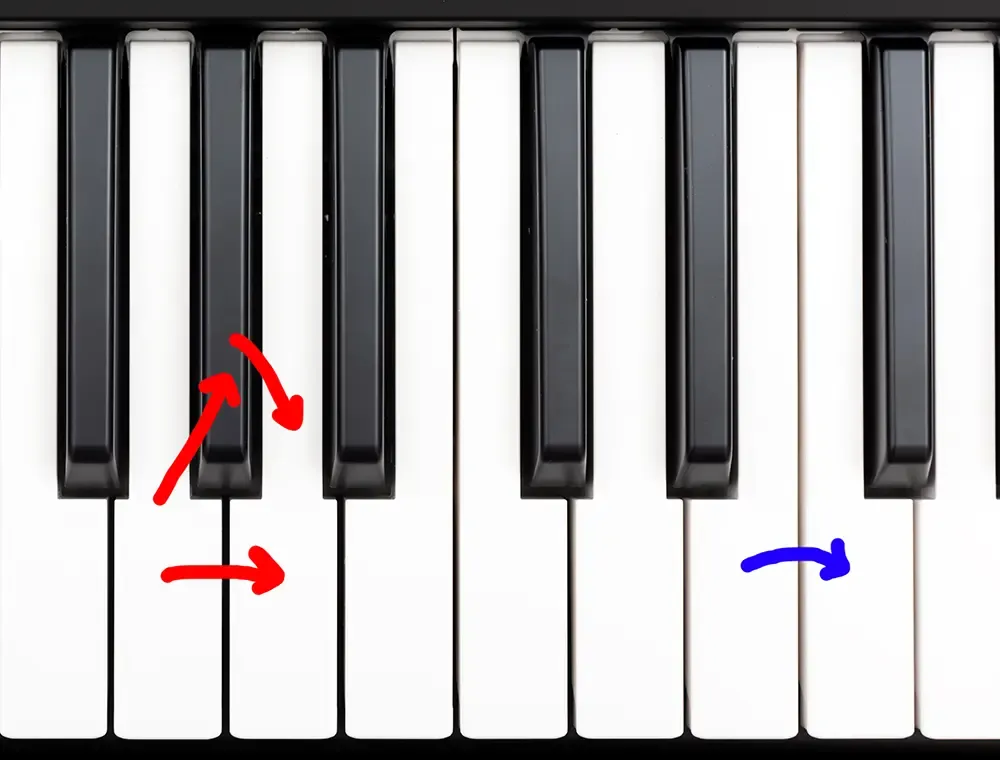
The red arrows show a whole step move and the blue arrows show a half step move. (Notice that the red whole step moves up to the next black key and then again to the next white key.)
Why is this important? Because where those half step moves sit in typical Western scales sets the tone for the whole set of notes.
Major Scales
Major scales use a pattern that has a half-step between the 3rd and 4th notes and the 7th and 8th notes of the scale. Everything else is whole steps. And that ends up giving you something like this:
C Major
C Major = C-D-E-F-G-A-B-(C)
That one is all the white keys on the keyboard.
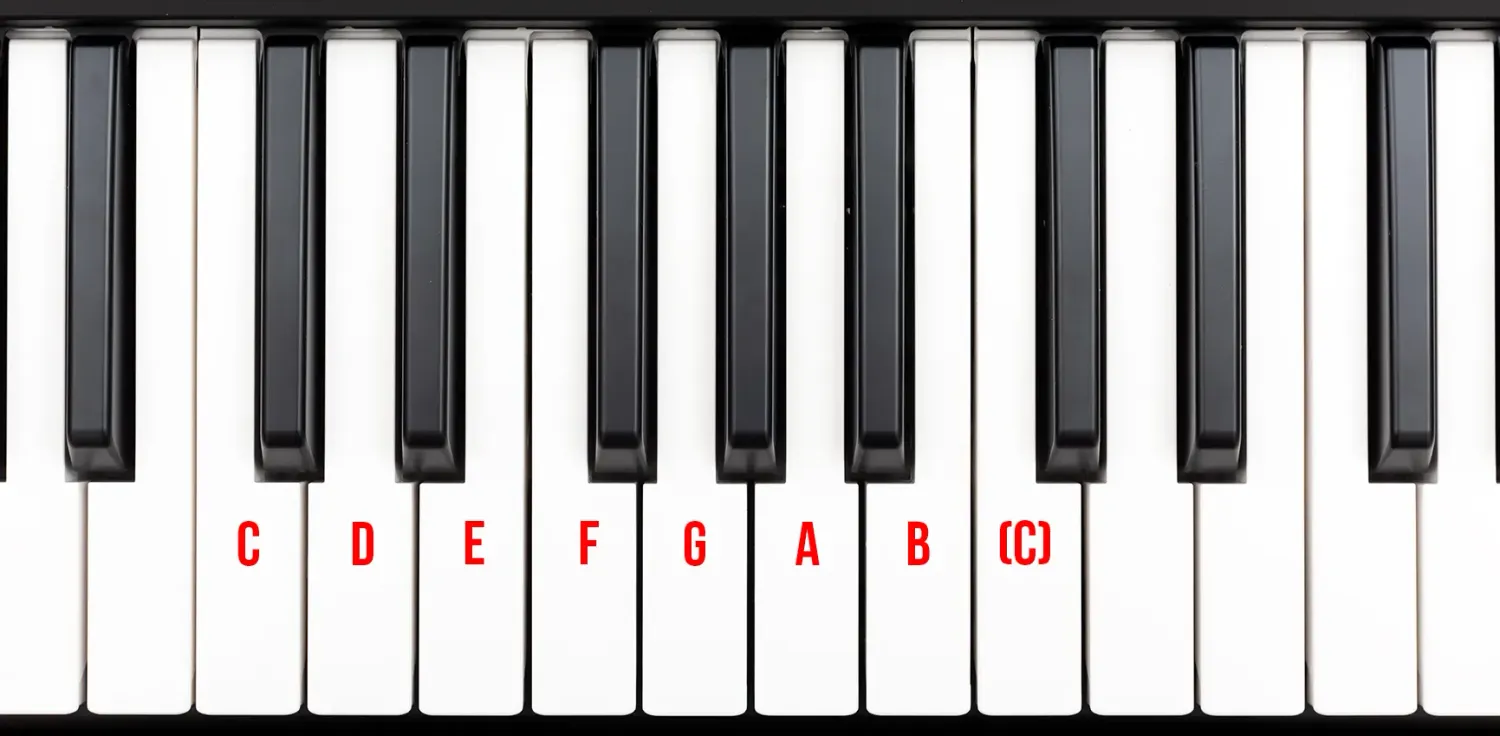
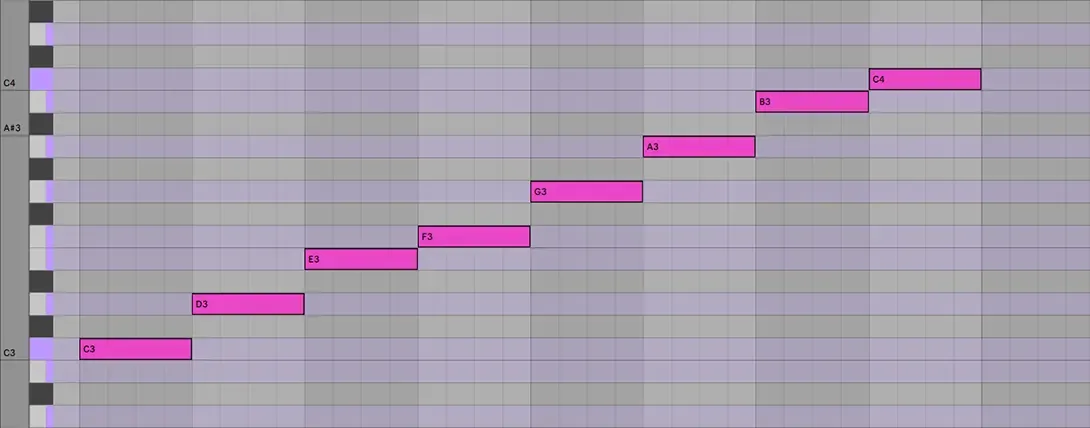
DAW interface shown: Ableton Live MIDI Note Editor
C# Major
Start on a different note and you get a different set with the exact same half-step location.
C# Major = C#-D#-F-F#-G#-A#-C-(C#)
That one uses all of the black keys.
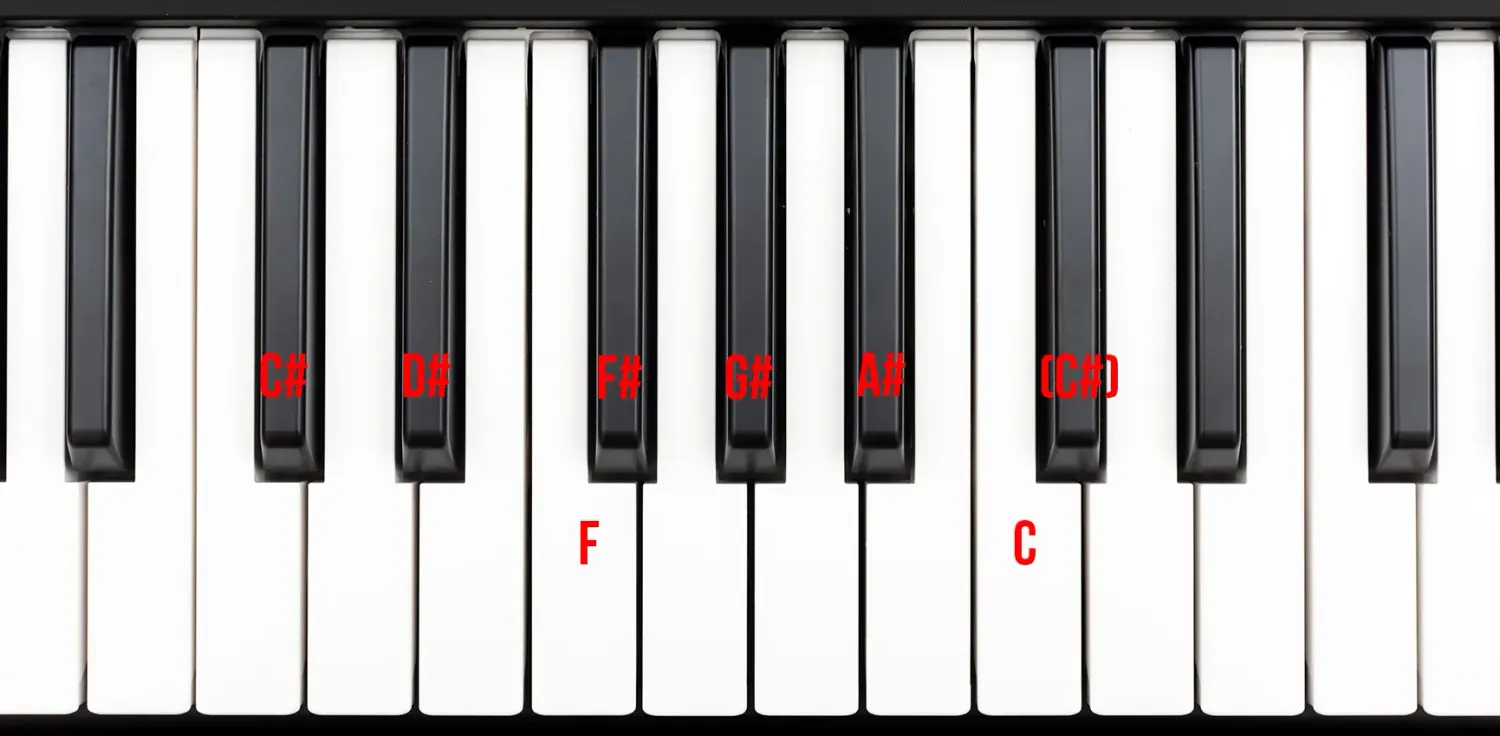
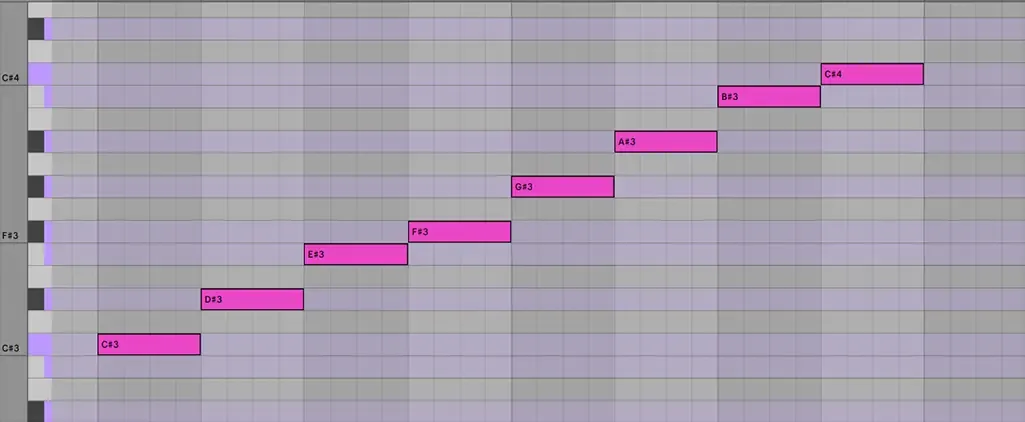
DAW interface shown: Ableton Live MIDI Note Editor
What Do Your Ears Tell You?
When you listened to both of these examples, did you notice that the major scales tend to feel pretty happy and energetic?
Pro Tip: Did you notice that I put the 8th note of the scale in parenthesis? That's called an octave, which is the same note but at double the frequency.
The C# Major Naming Trap
Did you notice that when I wrote out the notes of the C# Major scale that we ended up with two F notes (F & F#) and two C notes (C & C#)? Well, that kind of layout drives the academic textbook types completely insane.
Because they insist every scale must use every letter of the alphabet exactly once, they will literally force you to write the scale like this: C#–D#–E#–F#–G#–A#–B#–(C#).
Think about how detached from reality that is. An "E#" is literally just the physical F key on your keyboard, and a "B#" is just the physical C key. Forcing yourself to think in fake notes is pure madness when you are trying to write a track. Screw the textbook rules: use your ear, map the grid, and focus on the emotion.
Pro Tip: If you want to use this exact set of notes without the mental gymnastics, just switch the scale name to Db Major. You get a beautiful, clean lineup: Db–Eb–F–Gb–Ab–Bb–C–(Db).
The academics stay calm, your DAW grid stays clean, and you get straight to making music.
Minor Scales
Minor scales use a pattern that has a half-step between the 2nd and 3rd notes and the 5th and 6th notes of the scale. Everything else is whole steps.
And that ends up giving you something like this:
C Minor
C Minor = C-D-Eb-F-G-Ab-Bb-(C)
Now we end up with a mix of white and black key groupings.
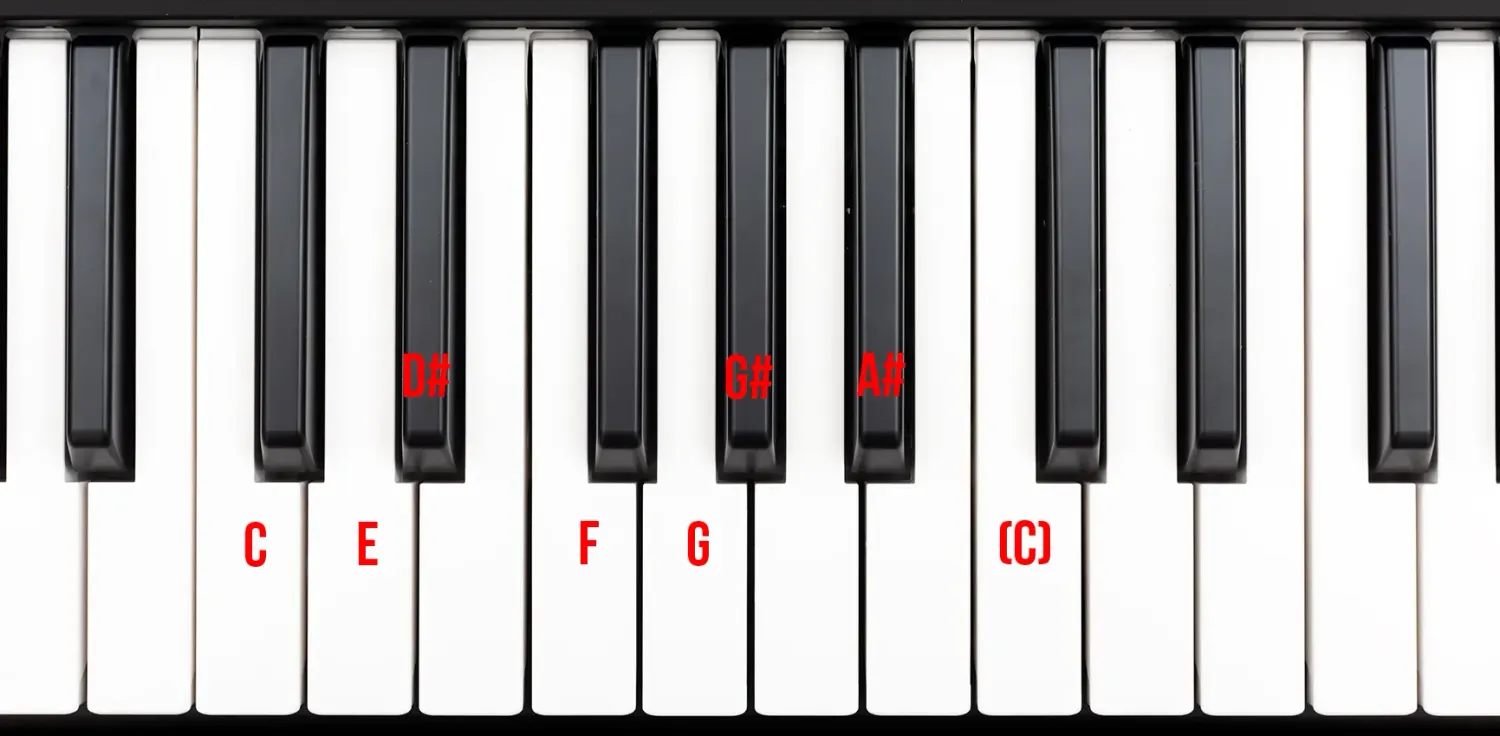
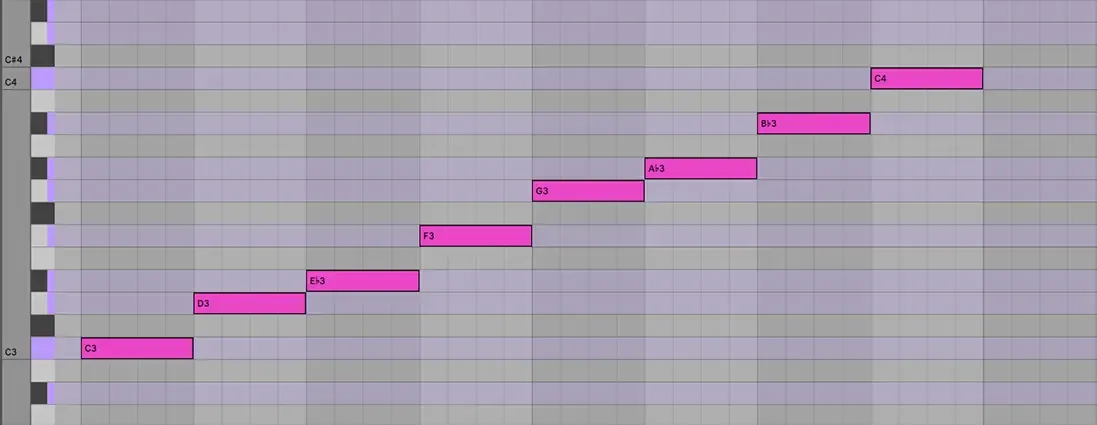
DAW interface shown: Ableton Live MIDI Note Editor
A Minor
A Minor = A-B-C-D-E-F-G-(A)
What the fritz? Those are the same all-white keys like with C Major!
Pro Tip: Using the notes of one scale while starting on a different note is called a mode - we'll talk about that in the next section.
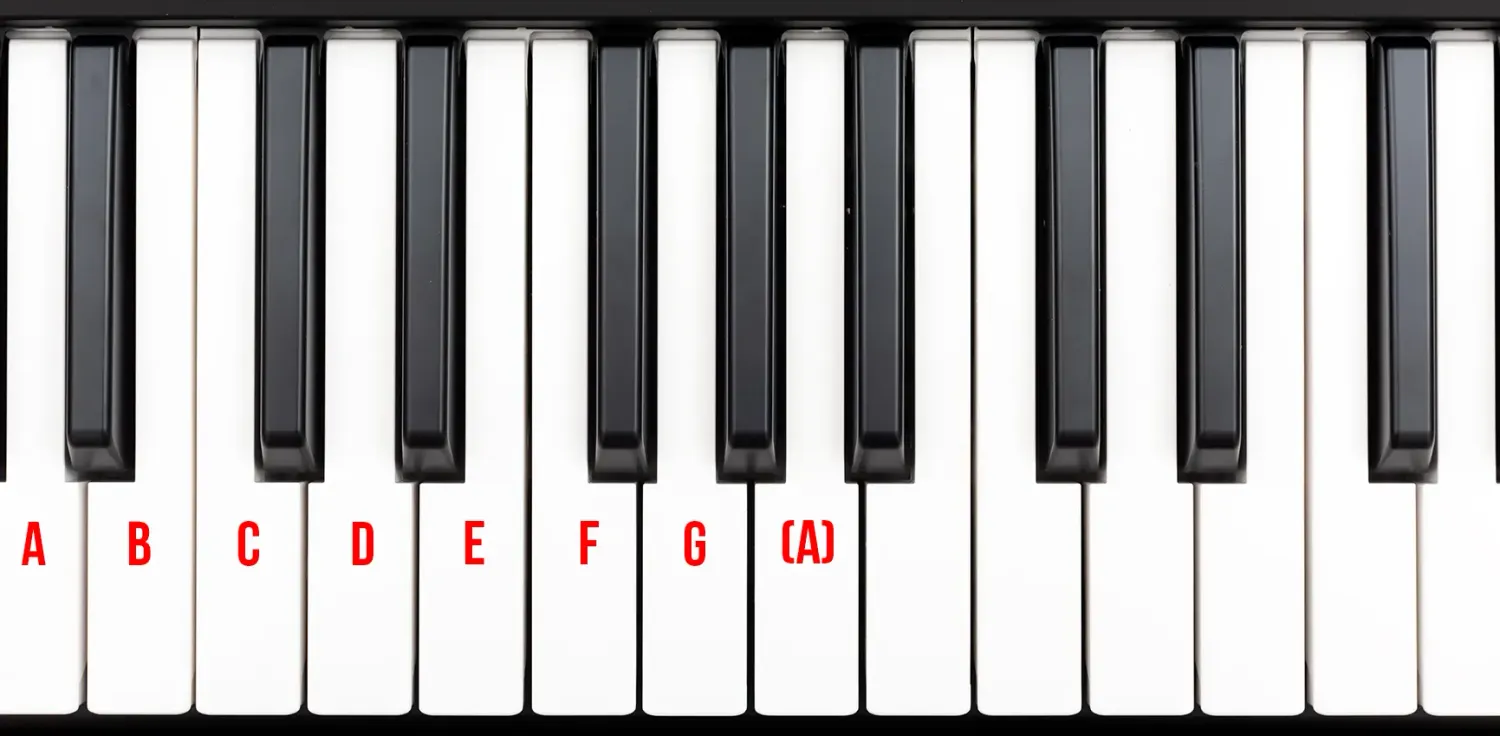
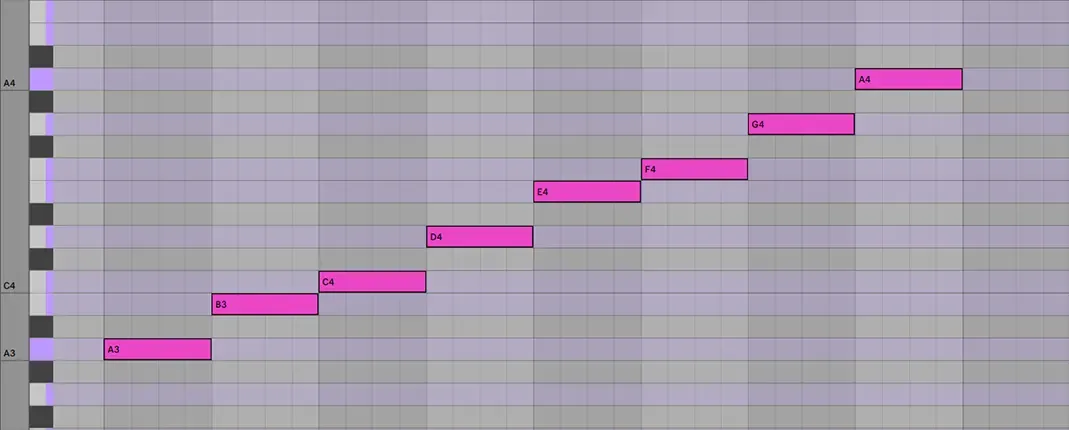
DAW interface shown: Ableton Live MIDI Note Editor
What Do Your Ears Tell You?
When you listened to both of these minor scale examples, did you notice that they tend to feel kind of sad or melancholic?
Understanding the emotional core of your song can help you with which scale might work best for you.
Other Scales
So, are there other scales beyond major and minor? Absolutely!
Do you need to worry about them right now? Absolutely not!
Here is the cheat code for other scales: Remember that placement of the half-step move? Well, if you fiddle with it, you create other scales.
Give it a try if you want - take a minor scale and move the second half-step to the 7th note instead of the 6th. What does it sound like to you? Can you hear how the emotion of the notes changes?
Modes in Music Theory: Same Notes, Different Flavor
Do you remember how the A minor scale used the same notes as the C Major scale? Well, it turns out that if you know any major scale, you automatically know another minor scale.
That's right - all you have to do is shift the start note of the scale to the 6th note of the major scale and boom - you have a minor scale.
That shift in the start note is called a mode.
Minor = Mode?
Check this out:
C Major scale = C-D-E-F-G-A-B-(C)
Let's keep following the notes further up: C-D-E-F-G-A-B-(C)-(D)-(E)-(F)-(G)-(A)
Okay, now let's just start from the A and go up one octave.
We end up with: A-B-C-D-E-F-G-(A)
Look at that - we have the exact notes of the A minor scale.
Pro Tip: This cheat code works on every major scale - give it a try for yourself!
Rinse & Repeat
So, get this - you are not limited to only starting with the 6th note. You can start with any of the notes and just extend the major scale and you end up with a different flavor of sound.
Think of the possible combinations you have unlocked here! If there are twelve major scales and each one of them has seven different starting points, you have loads of different scales you can use right off the bat.
And all of this works because it nudges the placement of those half-step moves - that's it!
Let's look at some key modes to know:
Dorian = 'Half' Minor
All of the modes have Greek names assigned to them. These specific names are not important right now, but what they represent is important.
With the Dorian mode (that's its Greek name) you just start on the second note of the scale. It is pronounced Door-ee-an.
Take the notes of C Major and extend them an octave up to D and you get C-D-E-F-G-A-B-(C)-(D)
That makes D Dorian = D-E-F-G-A-B-C-(D)
That's it - just start on the second note. Dorian modes tend to have a bit of a half-minor kind of feel. It's still minor, but is kind of hopeful at the same time.
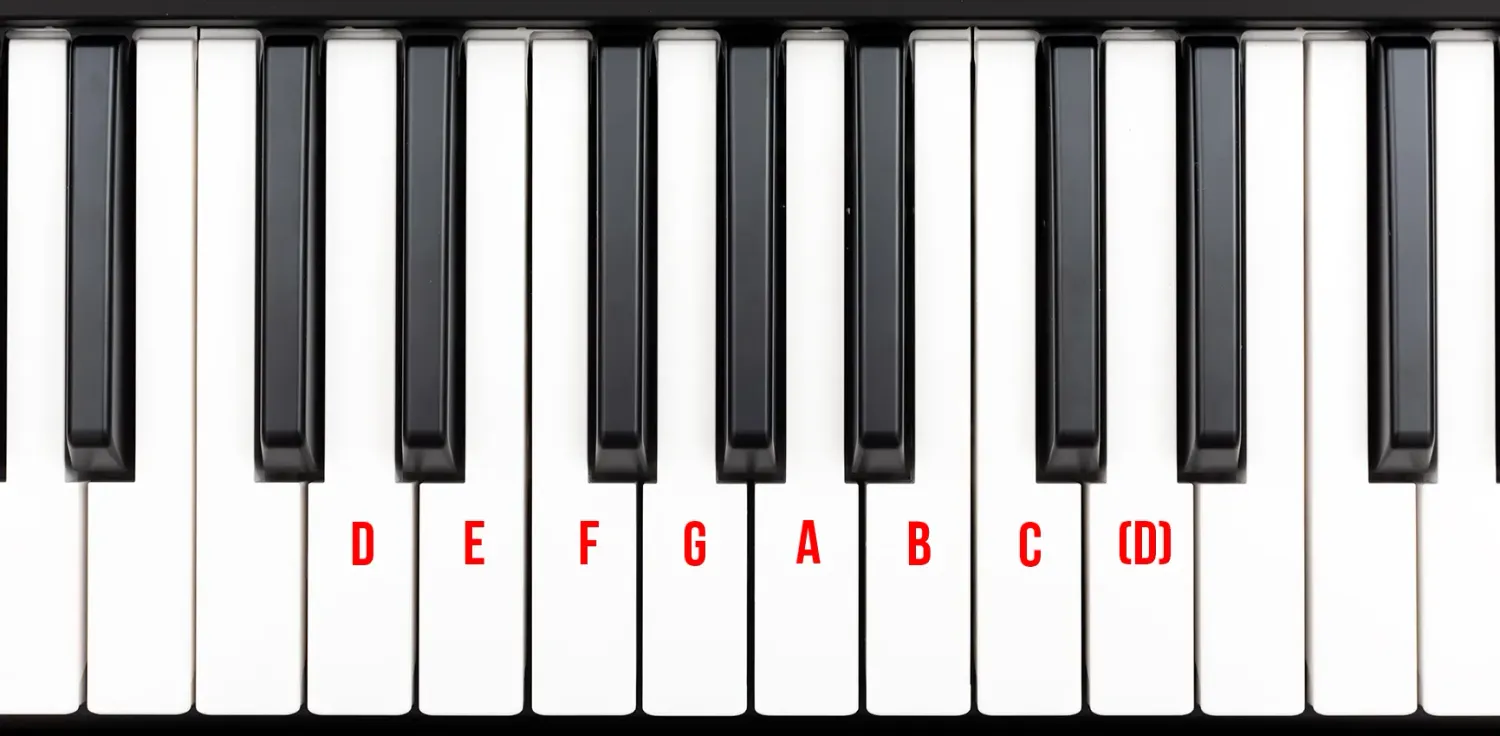
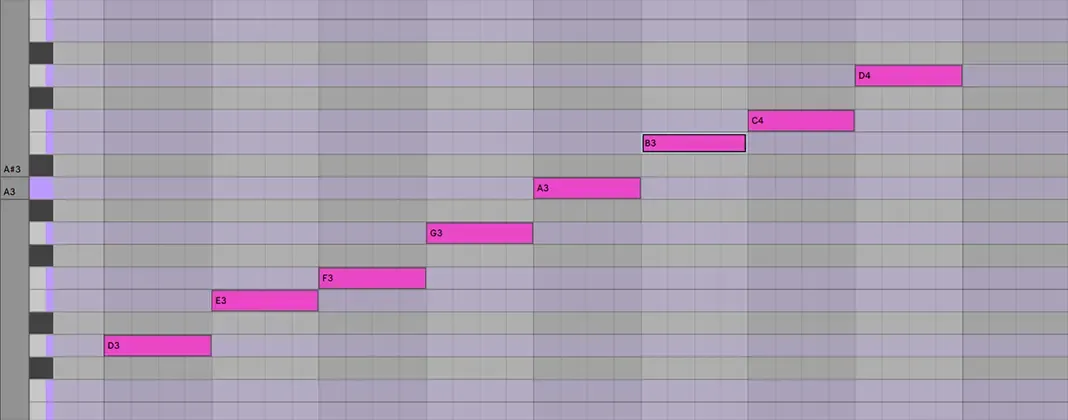
DAW interface shown: Ableton Live MIDI Note Editor
Mixolydian = Your Funky Friend
Face it - it's hard to get a cooler name than Mixolydian (Mix-oh-lid-ee-an). I remember when I was playing in a jazz band in high school and the song we were working on was called Mixolydian Soul Frog. It's pretty hard to forget Mixolydian when you are playing a song like that.
Mixolydian starts on the 5th note. Taking our C Major notes and starting on the fifth gets us starting with G like this: G-A-B-C-D-E-F-(G) to end up with a G Mixolydian scale.
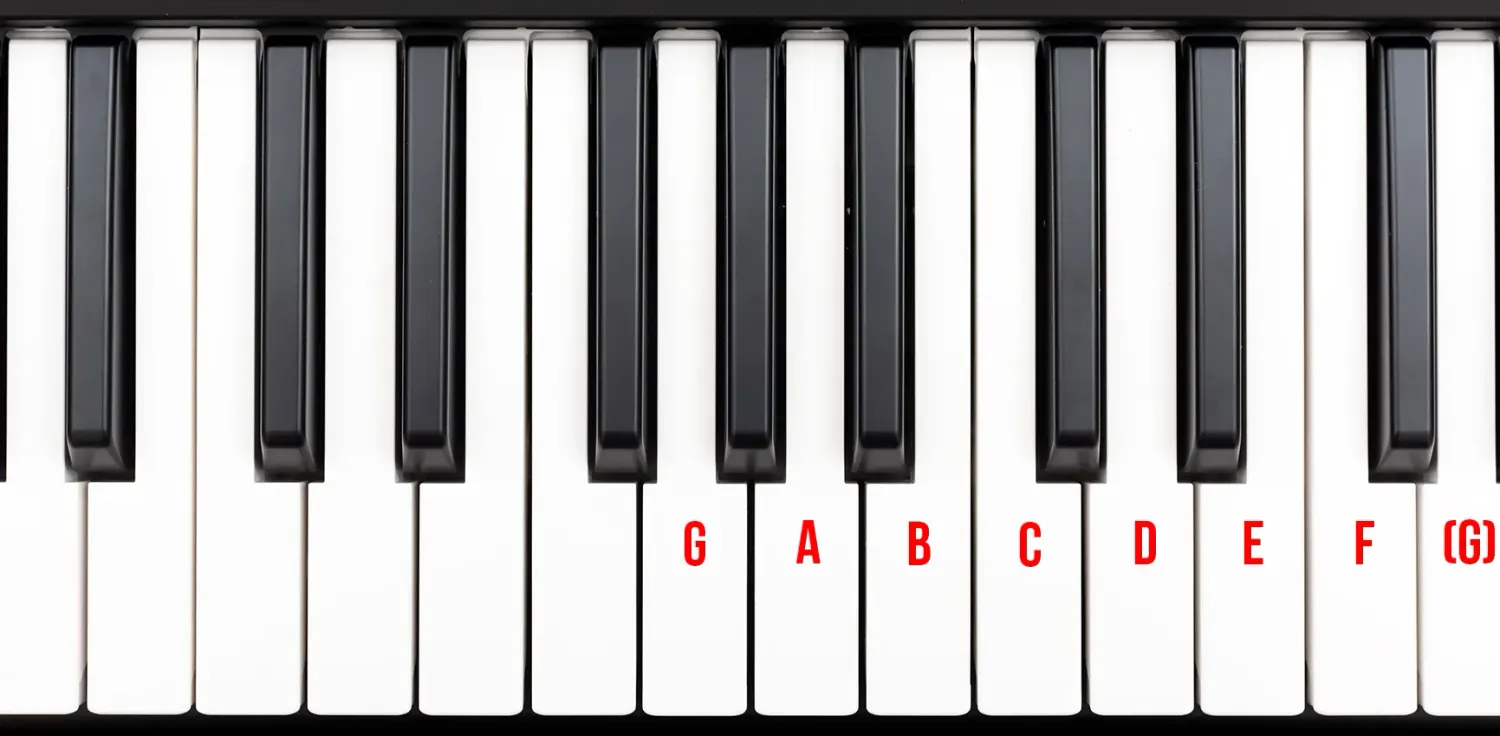
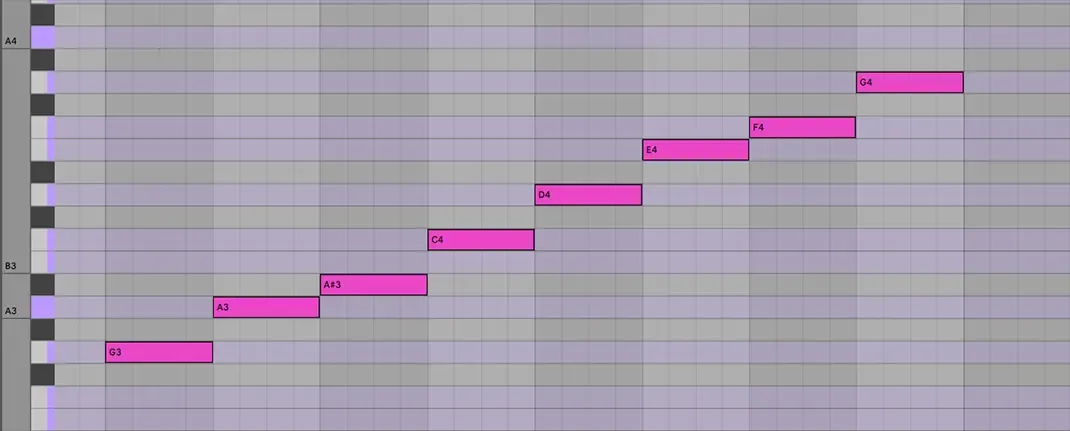
DAW interface shown: Ableton Live MIDI Note Editor
Other Modes
You have the cheat code to make whatever mode you want. Go nuts and have some fun playing with this.
Listen carefully to how these make you feel, because your ear and your gut are the ultimate judges of whether you should use one scale over another for whatever song you are going to work on next.
A Forever Mistake
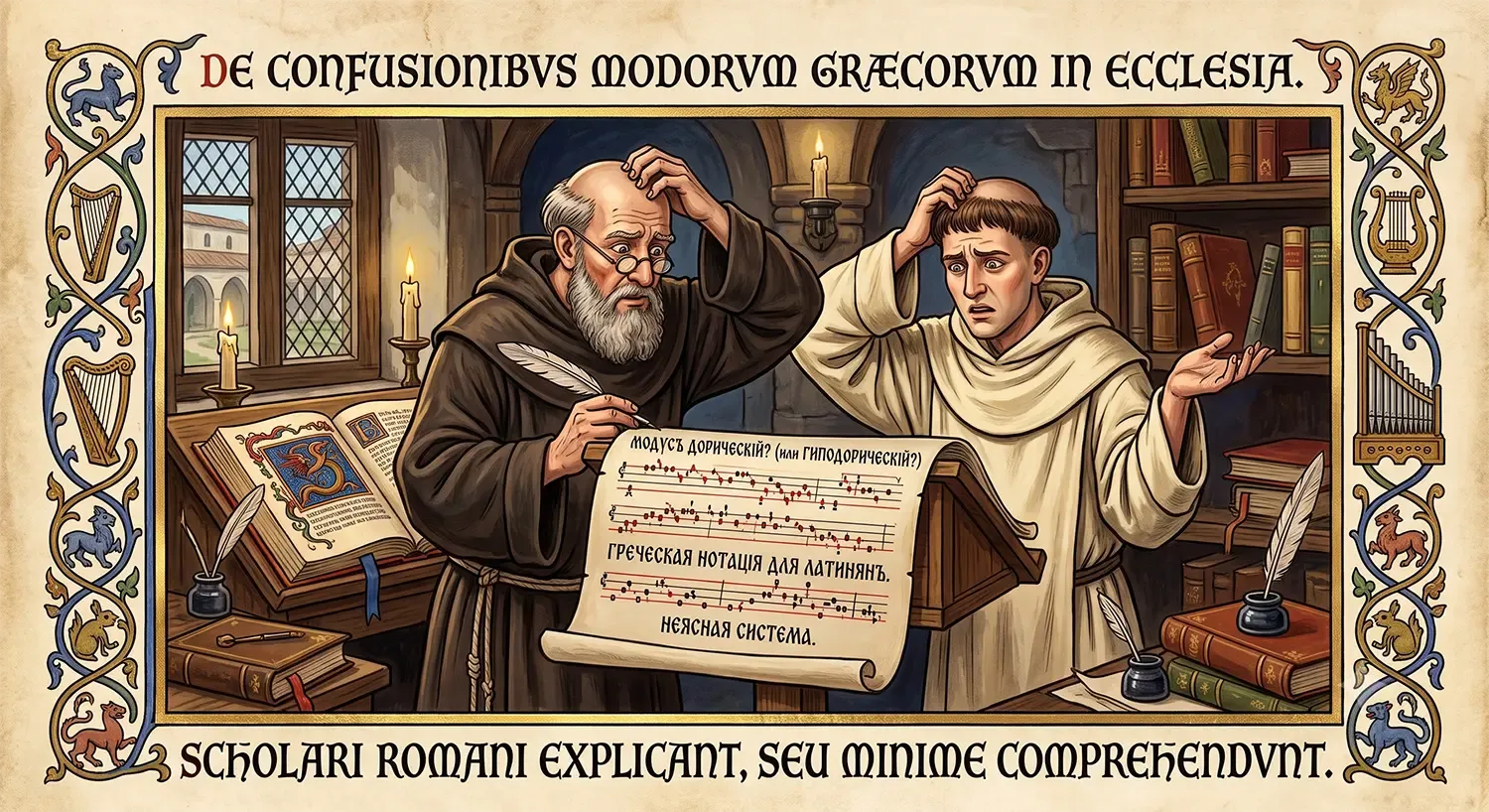
Fun fact - If you feel intimidated by terms like 'Phrygian' or 'Mixolydian,' don't be. You are literally getting confused by a 1,000-year-old translation mistake made by monks who couldn't read Greek properly.
I'm serious - some monks screwed up the original Greek names for modes and mixed up the order. So today, modern producers are stuck using a botched, medieval Latin interpretation of Greek geography just to say, "play the white keys starting on F."
Don't worry about the names - just worry about what the note shifts do and how they make you feel when you play the notes in that order.
How Chords Work (Simplified)
Chords are nothing more than a grouping of notes played together. They could be two notes or a handful of notes - it doesn't matter: they are just groups of notes.
And the most stable chords typically just skip over every other note in a scale. So, if you know the notes of the scales that we already worked through, you can get your chords going very quickly.
Chord Example - C Major
Let's break this down with C Major once again.
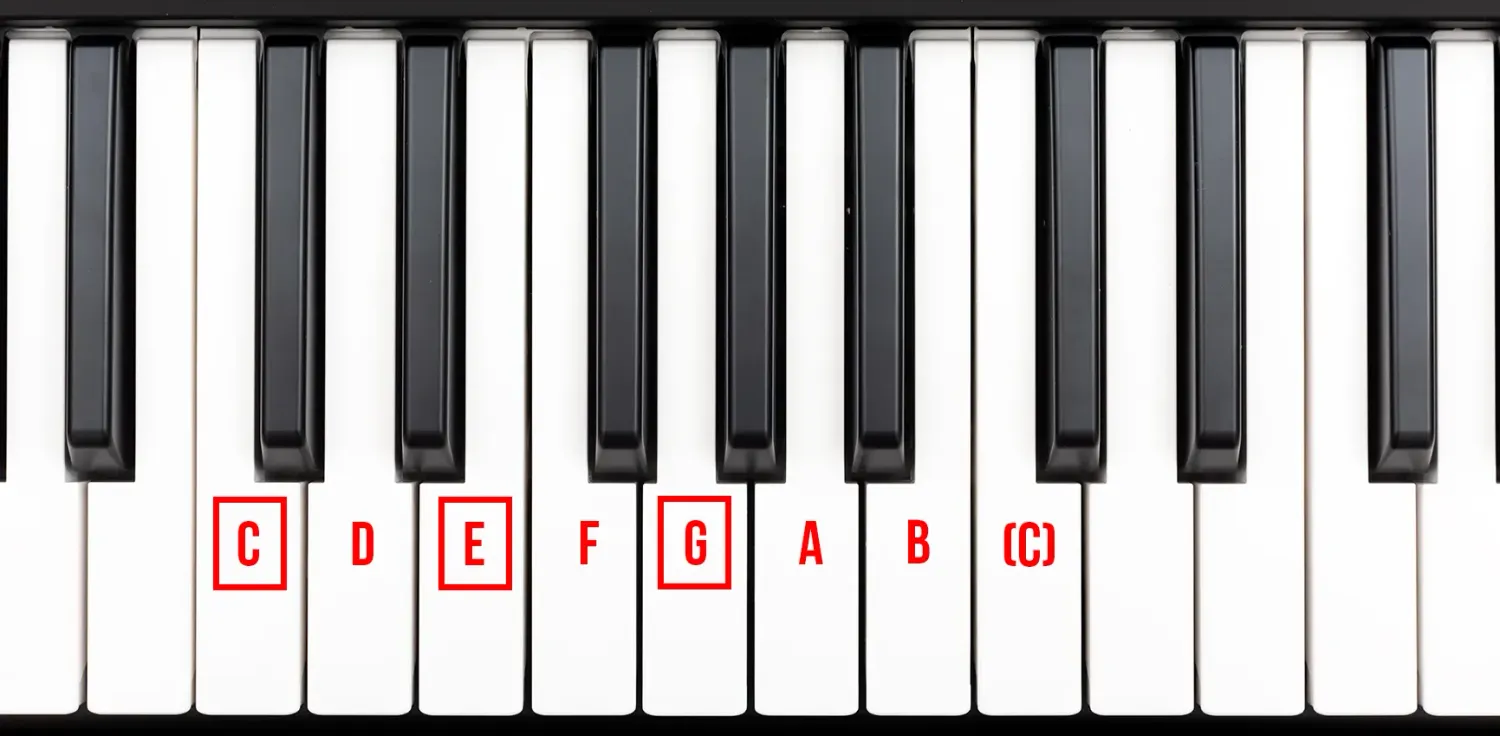
We take the scale and start with playing C, skip D, play E, skip F, and play G.
We play three notes, and that is called a triad. (That's a fancy word to say 'three notes played.)
It looks like this on the piano keys:
Rinse & Repeat
Guess what - you can simply change the starting note and move yourself right up the scale to make every chord. For C Major, here are each of those chords being played right in a row and a MIDI file with all of them in a row for you.
When you play this audio, listen for how each chord feels, because different chords highlight different notes of the scale. And that gives you control over the feelings being presented.
Give a listen to all of the C Major scale chords played in order and download the MIDI file below to play with it yourself. You can drop this right into your DAW starter template to instantly add these chords to your favorite instruments.
Other Chords
You saw how many combinations of scales we have with modes. Well, with chords it gets even crazier.
Because you don't have to use three notes and you don't have to skip every other note either. You can play two notes together - you can play five notes together - whatever you want as long as it sounds good and serves your song.
Play more notes and you can get into the jazzy territory. Play fewer notes and you can get effective simple chords like a guitar power chord. Experimenting with these combinations is a great way to build a productive music workflow.
You can move the middle note up or down a little - you can move the third note up or down a little.
You can even play some notes that aren't in the scale! That's right - pretty cool, eh?
Pro Tip: If you do start moving to notes that are not in the scale, it is best to start with only one note - leave the rest where they should be, so you don't lose touch with your home base. (More on that in a little bit.)

Chord Progressions - Building Emotional Movement
Dig this: These different chords you can play - if you play them in specific orders you are creating what is called a chord progression. That's just a fancy word to say you played more than one chord - literally.
Chords can be numbered depending on which note of the scale they start on. It is typical to use Roman numerals here. Each chord is numbered like this: I-II-III-IV-V-VI-VII
That C Major C-E-G chord would be a I chord. If you started on G, you would have a G-B-D (the V chord here as G is the 5th note of the C Major scale). Start on the F with an F-A-C and you have the IV chord as F is the 4th note of the C Major scale).
Now, play those in order and you get I-V-IV. And that is a chord progression.
Play with different orders of chords to get a feel for how your emotions move. Where do you feel tension building up and where do you feel it releasing?
Here are some example chord progressions:
I-V-vi-IV - (the 'every pop song ever' progression)
i-VI-III-VII - (trap, EDM, cinematic)
ii-V-I (jazz, neo-soul)
Pro Tip: Did you see how some of those Roman numerals were written in lower case and others in upper case? That is a shortcut way to know if you are playing a major (upper case) or a minor (lower case) chord.
Locking Your "Home Base" - Setting the Song Key & Using Tension
You might remember from the definitions section that the key of the song is the 'home base.'
That means this is the note that is the musical home. It is both the note and the scale that your song feels anchored to.
If you want the largest release, just remember to 'go home.'
How to Find Your Key (Fast)
Let's say you have a chord progression you worked out but you don't know what key it's in. No problem - time to use your ear and gut check this thing.
Play the chord progression one chord at a time. After each chord, ask yourself, does it feel like I came home?
If it feels like you are still on a journey, then try the next chord. One of those chords is going to feel like you have arrived home.
That is your key. It is the resolution that makes you feel "I'm done... I came home from the trip."
Big Emotional Movement
With your key locked, that means you can take that note and choose the scale you are playing in. If you have your chords already, make sure the notes match. Otherwise, if you are starting from a key you can select the type of scale (and mode if you are using one) to use.
Here are the cheat codes for emotional movement:
Major Key
Your I chord is your home base.
Your ii and viiº chords will feel like deep wilderness - you definitely will move to someplace else from here.
Your iii chord feels like a temporary sanctuary. It's a resting spot, but it's kind of dark and not home.
Your IV and vi chords will feel like you are going somewhere - through the wilderness. It kind of demands that you end up somewhere safer.
Your V chord will feel like a lift - a lookout tower. It feels good to be up there, but you can't stay there.

Minor Key
When you move from a major key to a minor key, the map stays the same but the weather changes, flipping some of the chords. Pay attention to the iiº, v and VI chords here:
Your i chord is your home base, but home base is kind of dark and the mood is more serious.
Your iiº and VII chords will feel like deep wilderness - you definitely will move to someplace else from here.
Your III chord feels like a temporary sanctuary. It's a resting spot and it feels pretty sunny, but it's not home.
Your iv and v chords will feel like you are going somewhere - through the wilderness. It kind of demands that you end up somewhere safer.
Your VI chord will feel like a lift - a lookout tower. It feels good to be up there, but you can't stay there.
Use Your Ears & Gut
These analogies are meant to give you a sense of being in the wilderness (tension) and coming home (release). You are not limited to only using these chords, but they do create a kind of traditional marker for emotional movements.
Play with the chords and how they feel. Play one and then another and see if it feels like you are getting to home or the lookout tower or the sanctuary.
With time and experimentation, using these chords will become more comfortable. And always use your ears and gut to feel out what makes sense - that is your best guide.
Using Tension Intentionally
Just like with storytelling of any kind, controlling tension helps to create emotional build-ups and impacts during a song.
The goal is to add tension when you want energy or emotion. Then, release that built-up tension when you want a payoff.
Too much tension or holding tension for too long will not feel comfortable. And too much release will steal the excitement from your track. Just like a good roller-coaster ride, there needs to be some gaps between the big thrills or they lose impact.
Some of the ways to use tension are:
Chords that want to go somewhere else (i.e., the wilderness chords)
Larger interval jumps in the melody
Extra notes in your chords
Borrowed chords (coming up next)

Borrowed Chords: Breaking the Rules (the Intermodal Hack)
Did you know you can borrow chords from other scales when you are playing and they can sound good? It's true!
Borrowing a chord has a fancy name: modal interchange. But that term doesn't really matter - what matters is what you get when you do this.
First, an Example
Let's imagine I have a chord progression like this: I-ii-V-I
That sounds like this:
Now, check this out - let's take that ii minor chord and swap it with a II major chord - that means our D - F - A notes of the ii chord switch to D - F# - A.
Check out how it sounds now:
Whoa! Did you hear how that changed the feel? Your brain goes, "Hey! That F# isn't supposed to be there," and then it feels a rush of relief as the tension resolves into the V chord (G Major).
You can download both of those chord progressions in one MIDI file right here - go play with them and check it out for yourself. Physically playing these chord changes on your MIDI controller helps to lock this kind of powerful technique into your muscle memory faster than using a mouse, so don't be afraid to have some fun here.
Where to Borrow From
There is a pretty wide range of targets to borrow chords from but remember - use this only here and there. If you overdo it, you lose the home base of your key. This is a powerful accent move to help drive tension and release.
You can borrow from some of the following sources:
A Parallel Minor (the same letter, but the minor scale, like C minor chords in a C major key)
Other Modes (grab a chord from one of those modes we learned about)
Shift the middle note of the V chord (bump the middle note of the V chord up or down and see how it sounds)
Why Borrowing Chords Works
Borrowing chords works because unlike those crusty academics, your ears don't care about rules, man. Your ears and your brain only care about the emotional journey they are experiencing.
You can add surprise, drama, freshness, movement, and color to your songs using this technique.
But remember - keep your home base solid. You key is your home; don't be too good for your home.
Why The Circle of Fifths is Completely Overrated for Producers
You’ve probably seen gurus praising 'The Chord Wheel' or the 'Circle of Fifths.' Let’s be real: if you have a functioning ear and write your own music, these circles are completely unintuitive.
They turn a linear timeline into a confusing clock. They pull you out of create mode and into technical/edit mode.
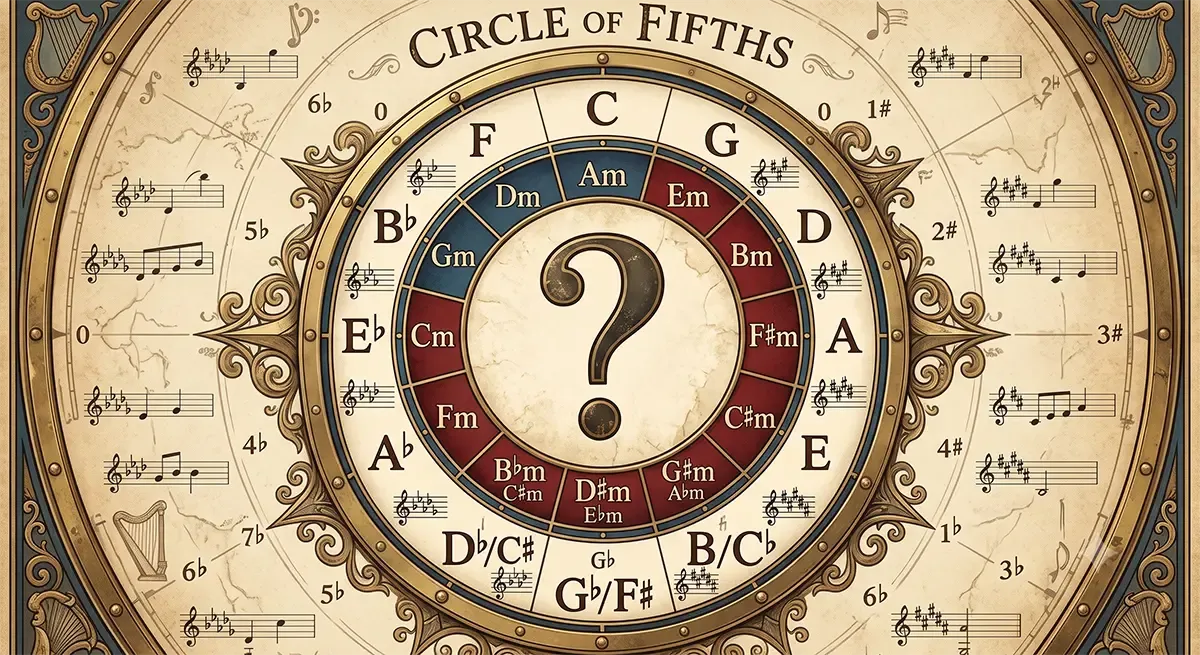
You don't need a wheel to pull off a massive, explosive Whitney-Houston-style key change, and relying on a wheel to match sample keys is a fast track to muddy basslines.
Here is how to actually map out chords in way that should feel more intuitive:
Do you remember the descriptions around your key's home base, lookout tower and wilderness zones? Well, these areas can be grouped into zones that you can work with:
Zone 1: The Landing Chords (Resolution & Rest)
These are your anchor chords. When you play a Landing Chord, the music should feel like it has pulled into a garage, hit a checkpoint, or returned safely to home base.
These chords are meant to provide release.
The Primary Landing Chord: The Root/Home chord (I in major, i in minor). This is your home base.
The Secondary Landing Chords: Chords that share a good number of notes with the home base (iii and vi in major, III and VI in minor).
The Ear Test: If you end your song (or song section) on a Landing Chord, the listener’s brain should feel stable. It should feel like there is nowhere else to go - like we are back home or at least on firm ground. This is a place where you can comfortably rest, even if the room is a little dark or shadowed.
Pro Tip: To accurately hear these tension and release frequencies, make sure you are using proper studio headphones or have basic acoustic treatment in your room so your basslines aren't lying to you.
Zone 2: The Travel Chords (Motion & Suspense)
These are your engines of tension and movement in the song - they make you feel like you are going somewhere. The second that you hear a Travel Chord, you have left the driveway and are moving through the world.
The music is now feeling like it's going somewhere - this is part of tension.
The Forward-Motion Chords: Chords that provide smooth, rolling momentum. You are traveling along the road (IV and ii in major, iv and v in minor).
The High-Tension Chords: These are where things can get intense. These are your 'lookout towers' or cliffhangers that carry a lot of transition energy. They want to go somewhere (V and viiº in major, VII and iiº in minor).
The Ear Test: A Travel Chord demands a destination. If you freeze a song on a Travel Chord, it feels like it is unfinished - it did not come to rest. You ear is actively wanting and predicting where these chords will land.
Making This Work Without Thinking
At the end of the day, it doesn't matter what tool or technique you use to learn how chords sound - you just need to feel them.
When you practice listening to your chords and how they feel as you move from one to another, you will get a sense for the chords that make you feel like they want to go somewhere and the ones that feel like you have arrived.
The more you learn to write music by ear instead of by doing math, the more productive your music workflow will be.
By the way, if you want to hear the power of a key change hit from Whitney, listen from 3:00 through about 3:12 in this video:
Frequently Asked Questions
Do I need a MIDI controller to learn music theory and write chords?
No, you can draw notes directly into your DAW's piano roll using your mouse. However, having a basic MIDI keyboard controller allows you to physically play chords and feel the "tension and release" in real-time, which significantly speeds up your music production workflow. There is a real advantage for creative people to feel the music they are playing.
What is a borrowed (intermodal) chord in music production?
A borrowed chord (or modal interchange) is when you temporarily use a chord from a different scale - like swapping a minor ii chord for a Major II chord. This breaks the predictable rules of your home key to add sudden emotional surprise, tension, and color to your song. This works well because the listener's mind is expecting something more predictable and you throw in a little surprise that catches attention.
Why do my big chords sound like a muddy mess?
When you stack more and more notes on top of one another, you create a combination of the primary tones and overtones (notes above the primary note). When you stack more and more notes together, the overtones from the lower notes start to clash with the primary tones above them. Besides working with your MIDI notes, you may also want to use equalization plugins to clean up some of that mud.
How does this music theory help me write better melodies?
It is really important to drive home any music theory knowledge you gain by putting it into practice. Remembering that your first attempts may not all be winners, use the concepts of scales, borrowed notes, and note intervals to focus on the kind of emotional storytelling you are going for in the song. Learning the notes of a scale is a great spot to start, followed by understanding how different note intervals convey emotion.
Where to Go Next
First, give yourself a pat on the back for making it this far - we covered a lot of material here. This isn't the end, but rather the start of your journey into understanding music theory.
Face it - music theory is like grammar: it's a toolset to explain what musicians tend to do. But it doesn't tell you what you're allowed to do.
Use your ears and try and break some 'rules' to see what you come up with.
The truth is, you can never really know enough about music theory, but you can definitely know too much of the boring stuff too early. But music theory is not about memorizing charts or impressing classical musicians - it's about understanding the emotional mechanics behind the music you love.
Now might be a great time to step away from the theory side of things and get to making a song. Put what you learned into practice and do some reps. If you want to see the song-creation process idea to finished song, check out the Embervane Sparkflow Map, a 35-page deep dive free resource that is waiting for you.
And as you see how making music will test your skills, you can jump into the free MIDI Madness Tier 1 course and up your music creation game.
Now get out there and go play with some of this new knowledge!
Found this guide helpful?
Spread the word and share with another creator.
Return to Writing Better Music Topic Hub
About the Author

Jim is the creator of Embervane - a lifelong music maker with a curiosity‑driven approach to creativity and learning. He has been playing drums since age nine and composing seriously since 2018, continually refining his craft through study, experimentation, and hands‑on practice.
With a background in chemistry and more than two decades of studying behavioral psychology, Jim brings a unique blend of scientific thinking and human understanding to music education. He beta‑tests tools for companies like Mastering the Mix, Kit Plugins, and Soundiron, which keeps him close to the evolving landscape of modern production.
Jim isn’t a celebrity producer or award‑winning engineer - he’s a creator who remembers exactly what it feels like to struggle, learn, and grow. His mission is to help other music makers build clarity, confidence, and momentum in their craft.
Jim is the creator of Embervane - a lifelong music maker with a curiosity‑driven approach to creativity and learning. He has been playing drums since age nine and composing seriously since 2018, continually refining his craft through study, experimentation, and hands‑on practice.
With a background in chemistry and more than two decades of studying behavioral psychology, Jim brings a unique blend of scientific thinking and human understanding to music education. He beta‑tests tools for companies like Mastering the Mix, Kit Plugins, and Soundiron, which keeps him close to the evolving landscape of modern production.
Jim isn’t a celebrity producer or award‑winning engineer - he’s a creator who remembers exactly what it feels like to struggle, learn, and grow. His mission is to help other music makers build clarity, confidence, and momentum in their craft.


©2026 Embervane LLC. All rights reserved. Embervane™ is a trademark of Embervane LLC.